Your plant's lower and middle leaves are turning yellow between the veins, but the veins themselves stay green. You've already fed it. You've already watered it. Nothing changed. That yellowing is almost never a sign you need more nutrients , it's a sign your roots can't access the magnesium already in the soil. And the culprit, nine times out of ten, is pH drift. This guide shows you how to diagnose magnesium deficiency with certainty, correct the root-zone pH that's causing lockout, and bring your plants back to full health within a week.
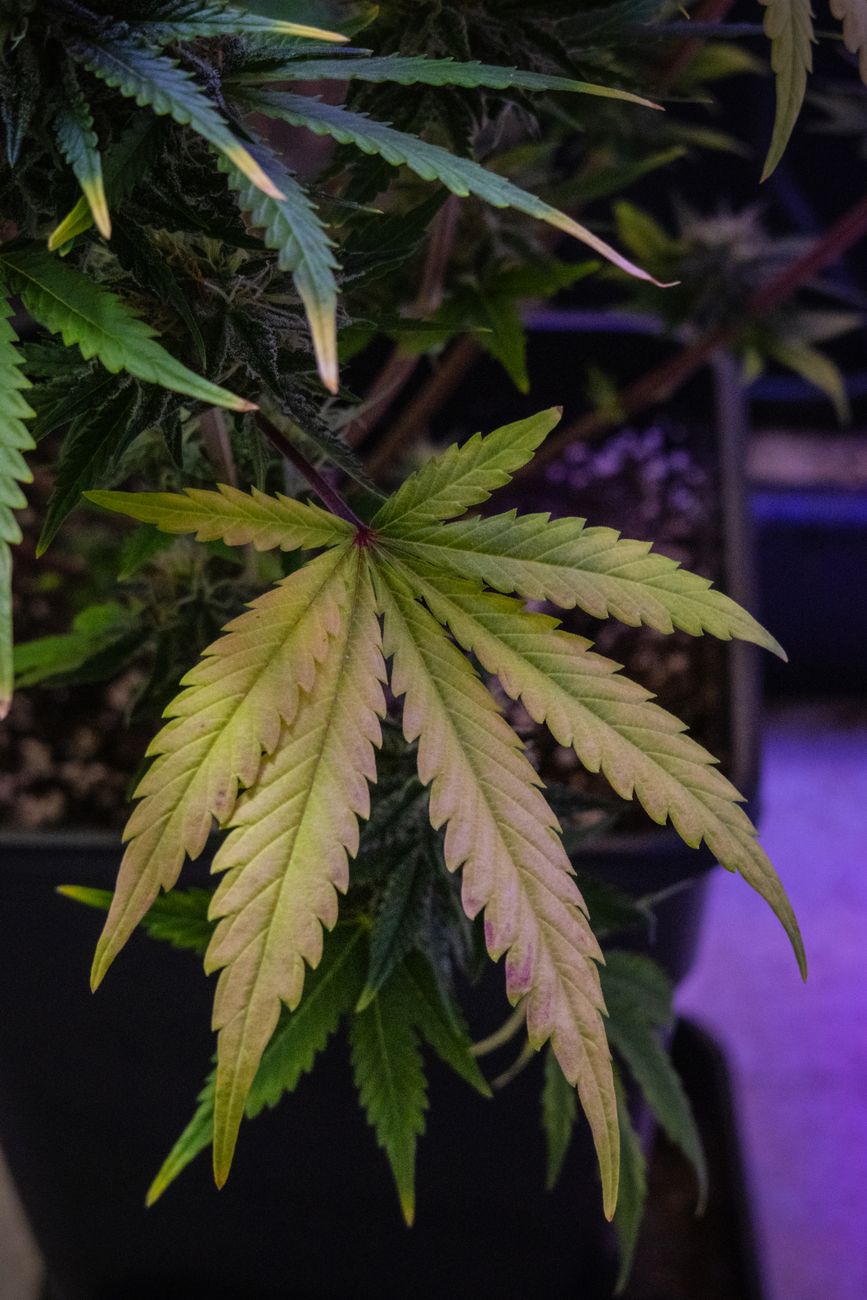
Magnesium deficiency in cannabis appears as interveinal chlorosis (yellow leaf tissue, green veins) starting on mid-to-lower leaves, moving upward as the deficiency worsens. It's almost always triggered by root-zone pH falling outside the optimal absorption window , below 6.0 in soil or below 5.5 in coco and hydro. Fix: flush with pH-corrected water (6.0-7.0 soil, 5.5-6.5 coco/hydro), then supplement with 5-10 mL of Epsom salt per litre of water. Most plants show visible recovery within 5-7 days.
- What is magnesium deficiency in cannabis?
- What does magnesium deficiency look like?
- What causes magnesium deficiency?
- How does pH cause nutrient lockout?
- How to fix magnesium deficiency step by step
- Does Epsom salt actually work?
- Magnesium vs. other deficiencies: how to tell them apart
- Who this guide is for
- Common mistakes growers make
- The pH-First Rule
- FAQ
- Sources
- ✓ Growers seeing yellow leaves mid-canopy with green veins
- ✓ Anyone using soft water or reverse-osmosis water
- ✓ Coco and hydro growers whose pH fluctuates frequently
- ✓ Outdoor growers in Canada dealing with acidic rain or runoff
- ✓ First-time growers unsure which deficiency they're looking at
- ✗ Growers with fully brown/crispy leaves (likely nutrient burn)
- ✗ Issues appearing only on new top growth (more likely iron/calcium)
- ✗ Growers who haven't confirmed their runoff pH first
What is magnesium deficiency in cannabis?
Magnesium deficiency is a condition where cannabis roots cannot absorb or transport enough magnesium to meet the plant's metabolic demand.
Magnesium is the central atom in every chlorophyll molecule. Without it, the plant cannot produce chlorophyll efficiently, which means it cannot photosynthesize at full capacity. It's also critical for enzyme activation and sugar transport from leaves to developing buds , making it especially important during flowering.
Because magnesium is a mobile nutrient, the plant pulls it from older (lower) leaves first and redirects it to new growth. That's why deficiency symptoms always appear at the bottom and middle of the canopy before spreading upward.
Magnesium deficiency is one of the most misdiagnosed problems in cannabis cultivation , growers either ignore it early or over-correct with excess nutrients. The key insight: it's almost always a pH-driven lockout problem, not a feeding problem. Check your pH before you do anything else.
What does magnesium deficiency look like?
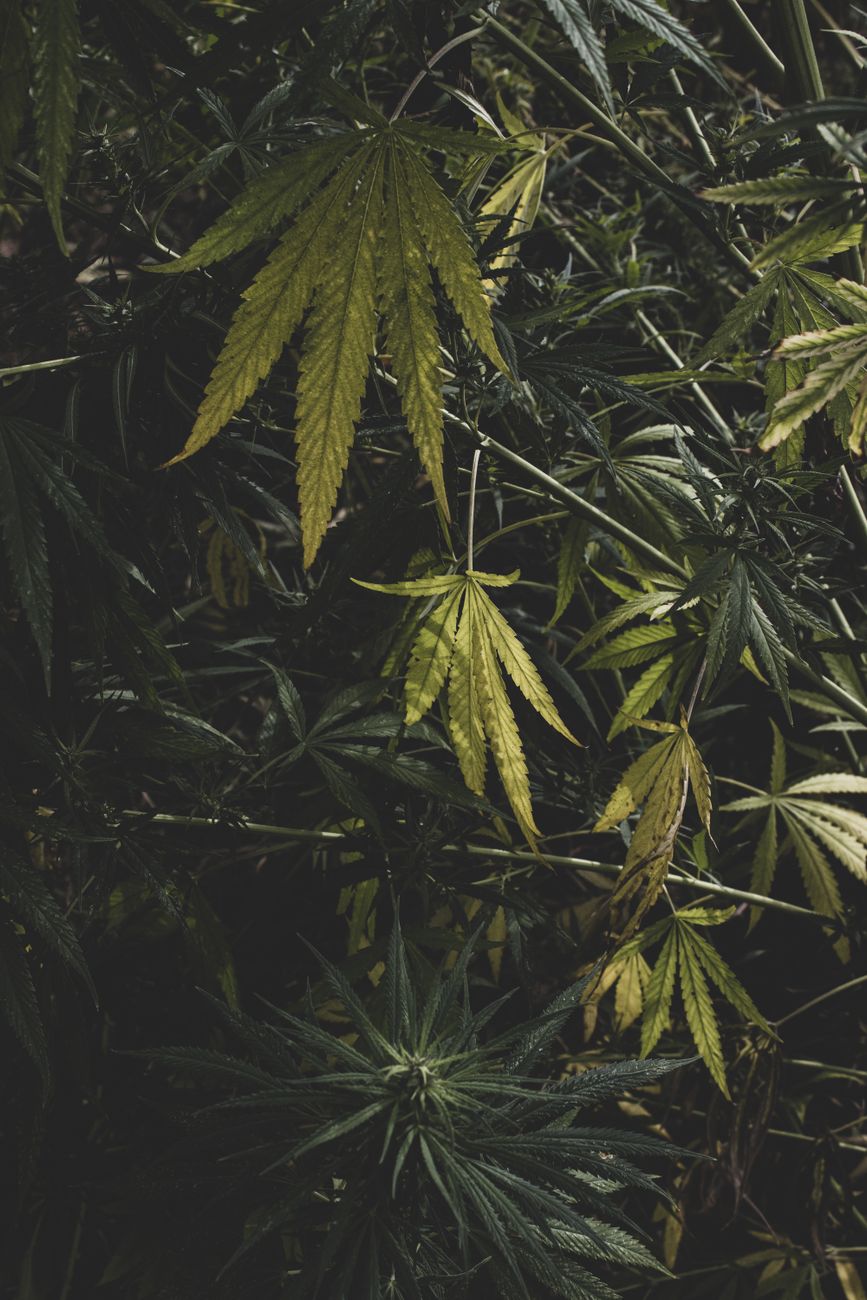
The primary visual sign is interveinal chlorosis , the tissue between leaf veins turns pale yellow or lime green while the veins themselves remain dark green.
This is what separates magnesium from most other deficiencies. The contrast between yellow lamina and green veins is sharp and distinct, especially under normal white or natural light.
A full symptom checklist:
- Interveinal yellowing on mid and lower fan leaves
- Yellowing starts at leaf margins and moves inward
- Affected leaves feel thin and papery as chlorophyll degrades
- In advanced cases, rust-coloured spots appear on yellowed areas
- New top growth remains healthy and green (initially)
- Symptoms worsen during heavy feeding or late flower when Mg demand peaks
Looking at grower reports and support questions fielded throughout the growing season, one consistent pattern stands out: magnesium symptoms are frequently mistaken for nitrogen deficiency because both cause yellowing on lower leaves. The difference is nitrogen deficiency produces uniform yellowing across the whole leaf , no green-vein contrast. Magnesium keeps the veins green. That single detail is your diagnostic shortcut.
If you see yellow leaves with clearly green veins starting at the bottom of the plant, magnesium deficiency is your most likely diagnosis. Confirm it by checking root-zone pH before spending money on new nutrients.
What causes magnesium deficiency in cannabis?
The most common causes, ranked by frequency across aggregated grower reports:
- pH out of range: Magnesium absorption peaks between pH 6.0-7.0 in soil and pH 5.5-6.5 in coco/hydro. Below these ranges, Mg becomes chemically unavailable even when it's present in the growing medium.
- Soft water or RO water: Reverse-osmosis and soft water have very low mineral content. Without baseline calcium and magnesium already in the water (typically 40-60 ppm combined), plants run low fast.
- High potassium or calcium feeding: Excess K and Ca compete with Mg at the same cation exchange sites in root cells. A nutrient ratio imbalance , not a Mg shortage , can lock out absorption.
- Overwatering: Waterlogged roots lose efficiency at cation uptake. Magnesium is particularly vulnerable because it requires active root transport.
- Cold root zone: Root-zone temperatures below 18°C (64°F) significantly slow magnesium uptake. Canadian outdoor growers and basement setups often hit this, especially in spring and fall.
- Depleted medium: After 6-8 weeks in the same coco or soil, the growing medium's Mg reserves naturally run low, particularly in light mixes without added dolomite lime.
pH drift is responsible for the majority of magnesium lockout cases. Fix pH first. If symptoms persist after 7 days of corrected pH, then investigate nutrient ratios and root temperature.
How does pH cause magnesium lockout?
Nutrient availability in any growing medium is tightly controlled by pH , the concentration of hydrogen ions in the root zone. Each nutrient has a specific pH window where it remains soluble and biologically accessible to roots.
Magnesium availability drops sharply below pH 6.0 in soil. In that range, competing cations (hydrogen ions, aluminum ions in acidic soil) displace Mg from exchange sites on soil particles and root membranes. The magnesium is physically present, but roots cannot take it up.
In coco coir and hydro systems, the lockout threshold is slightly lower , pH 5.5 , but the principle is identical. pH below 5.5 in these media routinely causes simultaneous magnesium and calcium lockout.
| Growing Medium | Optimal pH for Mg | Lockout Risk Below | Lockout Risk Above | Competing Nutrients |
|---|---|---|---|---|
| Soil | 6.0-7.0 | pH 6.0 | pH 7.5+ | Ca, K, NH4 |
| Coco Coir | 5.5-6.5 | pH 5.5 | pH 6.8+ | Ca, K, Na |
| Hydroponics (DWC/NFT) | 5.5-6.5 | pH 5.4 | pH 6.8+ | Ca, Fe, Mn |
| Outdoor / Native Soil | 6.0-7.0 | pH 5.8 | pH 7.5+ | Ca, Al (acidic soils) |
You need a reliable pH meter , not strips, not guessing. Test your runoff pH (the water coming out the bottom of the pot) as well as your feed water pH. The runoff reading is what's actually happening at the root zone, and it's often very different from what you're putting in.
How to fix magnesium deficiency in cannabis: step by step
Step 1: Confirm the diagnosis visually
Look at the lower and middle canopy. You need to see yellow tissue between green veins , not uniform yellowing, not brown crispy edges. If the pattern fits, proceed. If it doesn't match, consult the comparison table below before treating.
Step 2: Test your runoff pH
Water your plant to 20-30% runoff and collect the water coming out the drainage holes. Measure it with a calibrated pH meter. If it reads below 6.0 (soil) or 5.5 (coco/hydro), pH correction is your priority , not adding Epsom salt yet.
Step 3: Flush the growing medium
Use 2-3 times the pot volume of pH-corrected plain water (no nutrients). For a 11 L pot, that's 22-33 litres of water run through slowly. This flushes accumulated salt buildup and dissolved minerals that were driving pH down. Check the runoff pH as you go , you're done when it stabilizes in the correct range.
Step 4: Reintroduce nutrients with added magnesium
Once pH is corrected, feed your normal nutrient solution at half strength and add Epsom salt (magnesium sulfate, MgSO4) at 5 mL per litre. pH-adjust the final mixed solution before applying. For the first feed, aim for the middle of the optimal pH window , 6.4-6.6 for soil, 5.8-6.0 for coco.
Step 5: Apply a foliar spray for faster response (optional)
Mix Epsom salt at 2-3 mL per litre of plain water, pH-adjust to 6.2, and spray directly on leaves during lights-off or in low light. Foliar absorption is faster than root uptake , you may see a visible colour response within 2-3 days. Don't spray under intense HPS or LED light as leaf burn can occur.
Step 6: Monitor for 7 days
Damaged leaves will not fully recover , they may green up slightly but won't return to full health. What you're watching for is the absence of new yellowing. New growth should come in green and healthy within 5-7 days. If it doesn't, re-check runoff pH and look for competing nutrient excess (high calcium or potassium feeds).
Most growers under-correct at step 3 , they flush too little water and the medium stays acidic. Three pot volumes minimum. Don't rush this step. It's the one that does the most work.
Does Epsom salt actually work for cannabis?
Yes. Epsom salt (magnesium sulfate, MgSO4) is a proven, widely used magnesium supplement for cannabis , both soil and hydro growers rely on it.
It dissolves readily in water, doesn't affect pH significantly at normal doses, and delivers bioavailable magnesium directly. Published horticultural research and aggregated grower journals consistently show symptom improvement within 5-7 days of root application and 2-3 days via foliar spray.
The critical warning: Epsom salt works when the deficiency is real. Applying it to a plant that already has correct magnesium levels but wrong pH will make no visible difference , and adding excess sulfate can slightly depress calcium uptake over time. Confirm the pH and confirm the diagnosis first.
Epsom salt is a cheap, effective, widely-available fix , but it's the second step, not the first. pH correction comes first. Epsom salt at 5-10 mL/L is the follow-up that replaces depleted reserves once the root zone can actually absorb them.
Magnesium vs. other deficiencies: how to tell them apart
Misdiagnosis is the main reason growers over-feed and make problems worse. Use this comparison to pinpoint the actual issue:
| Deficiency | Visual Pattern | Where It Starts | Veins | Mobile? |
|---|---|---|---|---|
| Magnesium | Interveinal yellowing | Mid/lower canopy | Stay green | Yes |
| Nitrogen | Uniform pale yellow | Lower leaves | Also yellow | Yes |
| Iron | Interveinal yellowing | New top growth | Stay green | No |
| Calcium | Brown spots, curled tips | New growth | Variable | No |
| Potassium | Brown-tipped, scorched edges | Older leaves, tips first | May yellow late | Yes |
| Sulfur | Pale/lime green overall | New growth | Also pale | No |
The single most useful shortcut: if it's starting at the top, it's an immobile nutrient (iron, calcium, sulfur). If it's starting at the bottom with green veins, it's magnesium.
When in doubt, take a photo of the affected leaf against white light, zoom in on the veins, and ask: are the veins still green? Yes + lower leaves = magnesium. Yes + upper leaves = iron. This one question eliminates half the possible diagnoses immediately.
Common mistakes growers make with magnesium deficiency
Mistake 1: Adding more nutrients before fixing pH
This is the most common error. More Mg in the feed does nothing if the root zone pH is 5.7 in soil , the plant simply can't uptake it. The extra salts compound the problem by pushing the pH further out of range. Always correct pH first.
Mistake 2: Diagnosing from the top of the plant
Growers often glance at the topmost leaves, see green, and assume no problem. Magnesium deficiency starts at the bottom and moves up. You need to physically look underneath the canopy at older growth , that's where the truth is.
Mistake 3: Using pH strips instead of a meter
pH paper strips have an error range of plus or minus 0.5 units. In cannabis cultivation, that's too imprecise , the difference between pH 6.0 and 5.5 is the difference between full Mg availability and partial lockout. A basic digital meter costing $30-$50 CAD gives you accuracy to within 0.1 units.
Mistake 4: Expecting damaged leaves to fully recover
Once chlorophyll is broken down in a leaf, it doesn't fully regenerate. The yellowed leaf might green up slightly, but it won't return to vibrant dark green. Don't judge your treatment by watching sick leaves , watch for new healthy growth instead. New leaves emerging green within 7-10 days is your confirmation the fix worked.
Mistake 5: Overdosing Epsom salt
More is not better. Aggregated grower reports show that doses above 15 mL/L of Epsom salt can begin to suppress calcium uptake and tip the medium's sulphate balance. Stick to 5-10 mL/L for root feeding and 2-3 mL/L for foliar. One correct dose at the right pH works far better than repeated heavy doses.
Mistake 6: Ignoring root temperature
Canadian growers running basement setups or early outdoor starts in spring regularly see magnesium symptoms that persist even after pH correction. If root-zone temperature is below 18°C, Mg transport slows dramatically regardless of soil chemistry. Warming the medium , even with a seedling heat mat under the pot , often resolves stubborn cases within days.
If you've corrected pH, added Epsom salt, and still see spreading yellowing after 10 days, check root temperature and verify your meter calibration. Those two factors account for the vast majority of "stubborn" magnesium cases that don't respond to standard treatment.
The pH-First Rule
Before treating any cannabis nutrient deficiency, correct root-zone pH first. Adding nutrients to a plant with wrong pH is like filling a clogged pipe , nothing gets through.
Formula: Runoff pH within optimal window + correct Mg supplement = recovery. Mg supplement alone (wrong pH) = no result.
Example: A grower notices interveinal yellowing on week 5. Runoff pH reads 5.8 in soil (lockout zone). They flush with 25 L of pH 6.5 water through their 11 L pot, let it drain fully, then feed at pH 6.4 with 5 mL/L Epsom salt. Seven days later, new growth comes in healthy and green. The Epsom salt got credit, but the flush is what made it work.
This principle applies to every secondary nutrient deficiency, not just magnesium. If you're seeing any deficiency symptom and your pH is off, always address pH first and give it 5-7 days before adding targeted supplements.
For growers running autoflower seeds, magnesium management is particularly important. Autos have compressed life cycles with no recovery weeks built in , a two-week magnesium lockout during flower represents a meaningful portion of the entire grow. Catch it early.
If you're growing feminized cannabis seeds in photoperiod grows with longer veg time, you have more runway to correct deficiencies before they compound into yield losses.
Plants with strong root systems handle nutrient stress better and recover faster. Browse our high-THC cannabis seeds , all sourced from documented genetics with proven vigour.
Shop All Cannabis SeedsFrequently Asked Questions
What does magnesium deficiency look like in cannabis?
What pH causes magnesium lockout in cannabis?
How much Epsom salt should I use for cannabis magnesium deficiency?
How long does it take for cannabis to recover from magnesium deficiency?
Can I fix magnesium deficiency with foliar spray alone?
Is magnesium deficiency common in autoflowers?
Why is my cannabis still yellowing after I added Epsom salt?
Does magnesium deficiency affect yield?
Is magnesium deficiency the same as calcium deficiency in cannabis?
Can too much calcium cause magnesium deficiency?
Should I worry about magnesium deficiency with outdoor cannabis in Canada?
What is the difference between magnesium deficiency and light burn?
Can I use dolomite lime to prevent magnesium deficiency in soil?
My cannabis leaves are yellowing fast , how do I know if it's urgent?
Do I need CalMag or is Epsom salt enough?
Strong genetics tolerate feeding fluctuations better. Explore our full seed catalogue, with indica seeds, sativa seeds, and autoflower seeds for Canadian growers.
Browse All SeedsSources
Shop Premium Cannabis Seeds
Browse our curated selection of cannabis seeds, carefully chosen for Canadian growers. Fast shipping, germination guarantee, and discreet packaging across Canada.
Explore more seed categories: