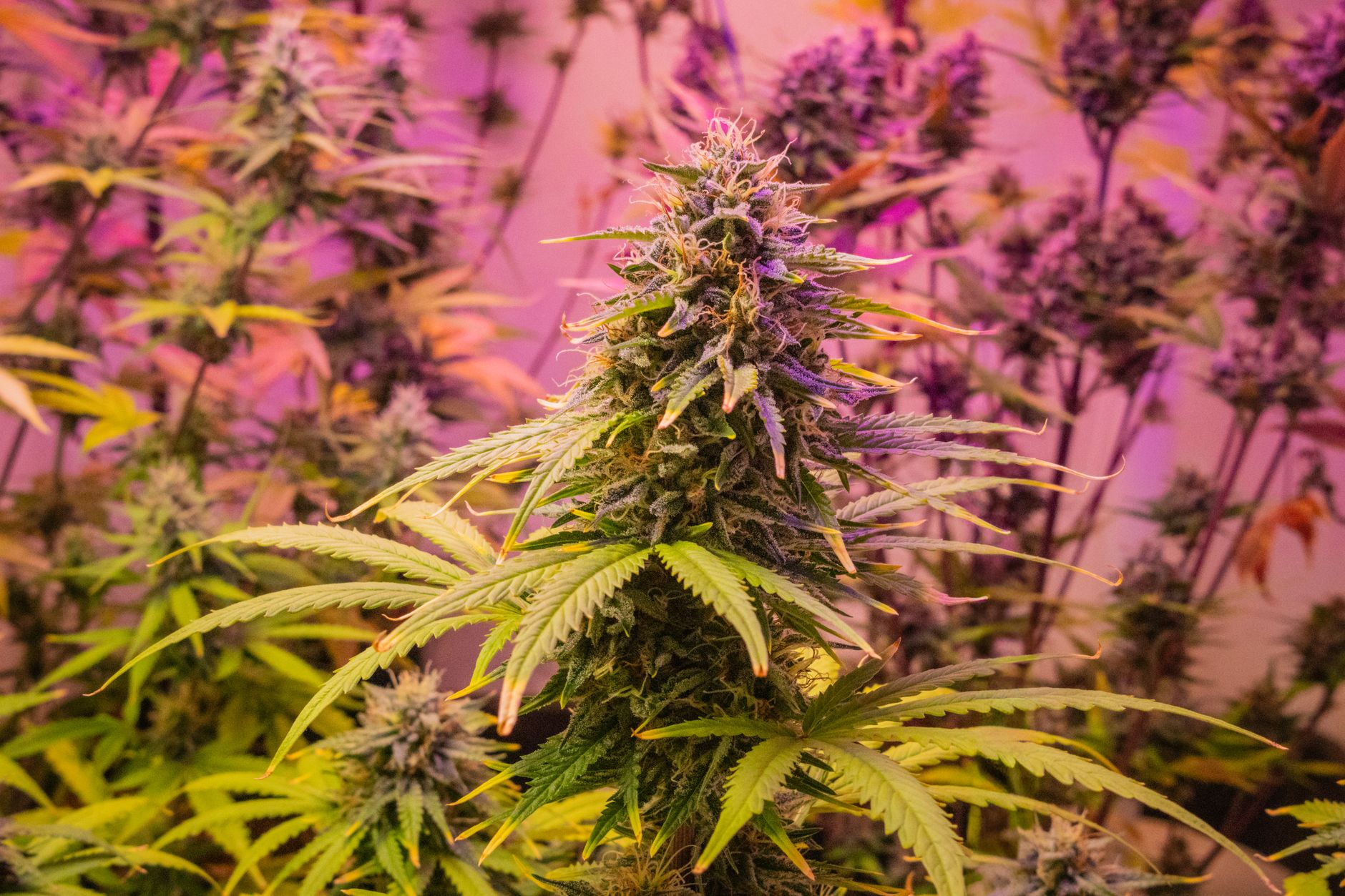
Cannabis training manipulates your plant's shape to maximize yield. Without training, cannabis grows one dominant cola, wasting light on lower branches.
This guide covers every major technique with difficulty ratings, timing, and autoflower compatibility.
Table of Contents
Why Train Cannabis Plants
Untrained cannabis grows vertically with one dominant cola. Training breaks this dominance and creates multiple main colas.
Training delivers these measurable benefits.
- Increased yield: Multiple equal-sized colas produce more total weight.
- Better light utilization: A flat canopy ensures optimal grow light coverage.
- Height control: Essential for tent growers with limited vertical space.
- Improved airflow: Open canopy structure reduces humidity and mold risk.
- More consistent buds: All colas receive similar light and develop equally.
Training is especially valuable with Canada's 4-plant limit. Proper technique increases per-plant yield by 20-40%.
Training Techniques Difficulty Comparison
This comparison helps you choose the right methods for your experience level and seed type.
| Technique | Type | Difficulty | Yield Boost | Autoflower Safe | When to Apply |
|---|---|---|---|---|---|
| LST | Low Stress | Easy | 15-25% | Yes | Veg, early flower |
| Topping | High Stress | Easy | 20-30% | Risky | Veg only |
| FIMing | High Stress | Moderate | 20-30% | Risky | Veg only |
| SCROG | Low Stress | Moderate | 25-40% | Yes | Late veg to flower |
| SOG | None | Easy | Per-area boost | Yes | Quick flip |
| Mainlining | High Stress | Advanced | 20-35% | No | Early veg |
| Lollipopping | High Stress | Easy | 10-20% | Careful | Early flower |
| Super Cropping | High Stress | Moderate | 15-25% | Risky | Late veg |
Start with LST and add techniques as your skills grow.
Low Stress Training (LST)
LST is the most beginner-friendly technique. It is the only method universally safe for both autoflowers and photoperiods.
Follow these steps to LST your cannabis plants.
Step 1: Wait for 4-6 Nodes
This typically happens around week 3-4 from seed. The plant needs enough growth to bend safely.
Step 2: Bend and Secure the Main Stem
Gently create a 90-degree angle away from center. Use soft plant ties attached to the pot edge.
Step 3: Tie Down Side Branches
Bend side branches to the same level as the main stem. Continue adjusting as they grow.
Step 4: Stop in Early Flower
Allow buds to develop upward 1-2 weeks into flowering. LST creates a bush-shaped plant with multiple equal colas.
Pro Tip: Bend stems when young and flexible. If a stem cracks, wrap it with plant tape. Cannabis heals quickly and the break often becomes stronger.
For Canadian growers with limited plant counts, LST is the easiest yield boost available.
Topping Cannabis Plants
Topping cuts off the main growth tip. This forces the plant to create two new main colas from the cut node.
Here is how to top correctly.
Step 1: Wait for 5-6 Nodes
The plant should be healthy and vigorous before any cutting. Stressed plants should not be topped.
Step 2: Cut Cleanly Above the 5th Node
Use sharp, clean scissors for a precise cut. Two new colas will form from branches at the cut node.
Step 3: Allow Recovery and Consider a Second Topping
Wait 1-2 weeks before additional stress. A second topping creates 4 main colas for an even canopy.
Combined with LST, a single topping dramatically improves canopy shape. Most feminized photoperiod plants respond very well.
For autoflowers, topping is debated. Beginners should use LST instead.
FIMing Cannabis Plants
FIMing removes about 75% of the new growth tip instead of all of it. This often creates 3-4+ new growth points.
Identify the very top growth point and pinch or cut most of the new growth, leaving 25%.
FIMing causes less stress than topping with faster recovery. Results are less predictable but can produce 4+ colas from a single FIM.
SCROG (Screen of Green)
SCROG uses a horizontal screen above the plants. Branches are tucked under the net to create a perfectly flat canopy.
Here is how to set up and maintain a SCROG.
Step 1: Position the Screen
Place netting with 5-10cm squares at 30-40cm above the pot. Top your plants to create multiple branches.
Step 2: Tuck and Fill
Guide growth horizontally through adjacent squares. Continue tucking until 60-70% of the screen is filled.
Step 3: Flip to Flower
Switch to 12/12 once the screen is adequately filled. Buds will grow vertically through the remaining squares.
A well-executed SCROG increases yields by 25-40%. A single plant can fill a 3x3 or 4x4 foot screen.
SOG (Sea of Green)
SOG grows many small plants close together, flowering them early. Each plant produces one main cola.
SOG follows these key principles.
- Many small plants: Use small 2-4 litre containers packed closely together.
- Flower early: Switch to 12/12 after only 1-2 weeks of veg.
- No training needed: Each plant grows one main cola naturally.
- Uniform genetics: Best results come from clones of a single mother.
SOG is less practical in Canada due to the 4-plant limit. However, a modified SOG with 4 autoflowers can produce quick harvests.
Mainlining and Manifolding
Mainlining creates a symmetrical plant with 8, 16, or 32 equally sized colas. It produces the most uniform results of any method.
Here is the mainlining process step by step.
Step 1: Grow to 5-6 Nodes
Let the plant develop fully before starting. Then top above node 3, removing everything above and below.
Step 2: Let Branches Develop
Wait until each branch has 3-4 nodes of its own. Then top each branch to create 4 total, repeating for 8 or 16.
Step 3: Spread with LST
Use ties for even spacing across the canopy. The payoff is beautifully uniform colas at harvest.
Mainlining adds 2-4 weeks to veg time, making it suitable only for photoperiod plants.
Lollipopping for Bigger Buds
Lollipopping removes lower growth during early flowering. The result is bare stems below with buds concentrated at the top.
Follow these lollipopping guidelines.
- When: During the first 1-2 weeks of flowering, before buds develop.
- What to remove: Small branches and bud sites on the lower third.
- How much: Remove all growth below the SCROG screen or lower canopy.
- What to keep: Healthy fan leaves on upper branches that power buds.
Without lollipopping, plants waste energy on small "popcorn" buds. Redirecting that energy produces larger, denser top colas.
Super Cropping (High Stress Training)
Super cropping intentionally damages a branch's inner tissue by squeezing and bending it. This creates a strengthened "knuckle" that boosts nutrient flow.
Here is how to super crop safely.
Step 1: Choose a Tall Branch
Target branches growing above canopy level. Squeeze the stem between thumb and forefinger until inner fibres soften.
Step 2: Bend to 90 Degrees
Fold at the crushed point without breaking the outer skin. Use a plant tie to prevent it from springing back.
Step 3: Wait for the Knuckle
Within 3-7 days, a thick knot forms that is stronger than before. This reinforced joint improves nutrient delivery.
Only super crop during late veg. Doing it during flowering can reduce bud development or trigger hermaphroditism.
Combining Training Techniques
The most successful growers combine multiple techniques. Choose the combo that matches your skill and seed type.
Beginner Combo (Autoflower)
- LST from node 4-5: Gently bend and tie the main stem and branches.
- Continue tucking: Keep training through early flower for an even canopy.
- Light lollipopping: Remove bottom growth in week 3 of flower.
Intermediate Combo (Photoperiod)
- Top once at node 5: Create two main branches from the single stem.
- LST to spread branches: Tie down growth for even distribution.
- SCROG net: Install a screen for canopy management during late veg.
- Lollipop below screen: Remove everything below the net in early flower.
Advanced Combo (Maximum Yield)
- Mainline to 8 colas: Build a symmetrical manifold during veg.
- LST into SCROG: Spread all 8 branches under the screen net.
- Super crop tall branches: Manage uneven growth during the stretch.
- Aggressive lollipopping: Remove all growth below the screen level.
Start simple and add techniques as your skills grow. A well-executed LST alone produces excellent results with seeds from our collection.
Frequently Asked Questions
What is the best training technique for cannabis beginners?+
Can I top autoflower cannabis plants?+
When should I start training my cannabis plant?+
What is the difference between topping and FIMing?+
What is SCROG and how does it increase yield?+
Is mainlining worth the extra time?+
What is lollipopping and when should I do it?+
Can I combine multiple training techniques?+
Does cannabis training increase yield?+
Ready to put your training skills to work? Browse our premium seeds.
Royal King Seeds Editorial Team
Editorial Team
Our editorial team cites public breeder documentation, lab COAs (SC Labs and Steep Hill), Health Canada guidance, and aggregated grower journals. We do not fabricate first-party trial data.