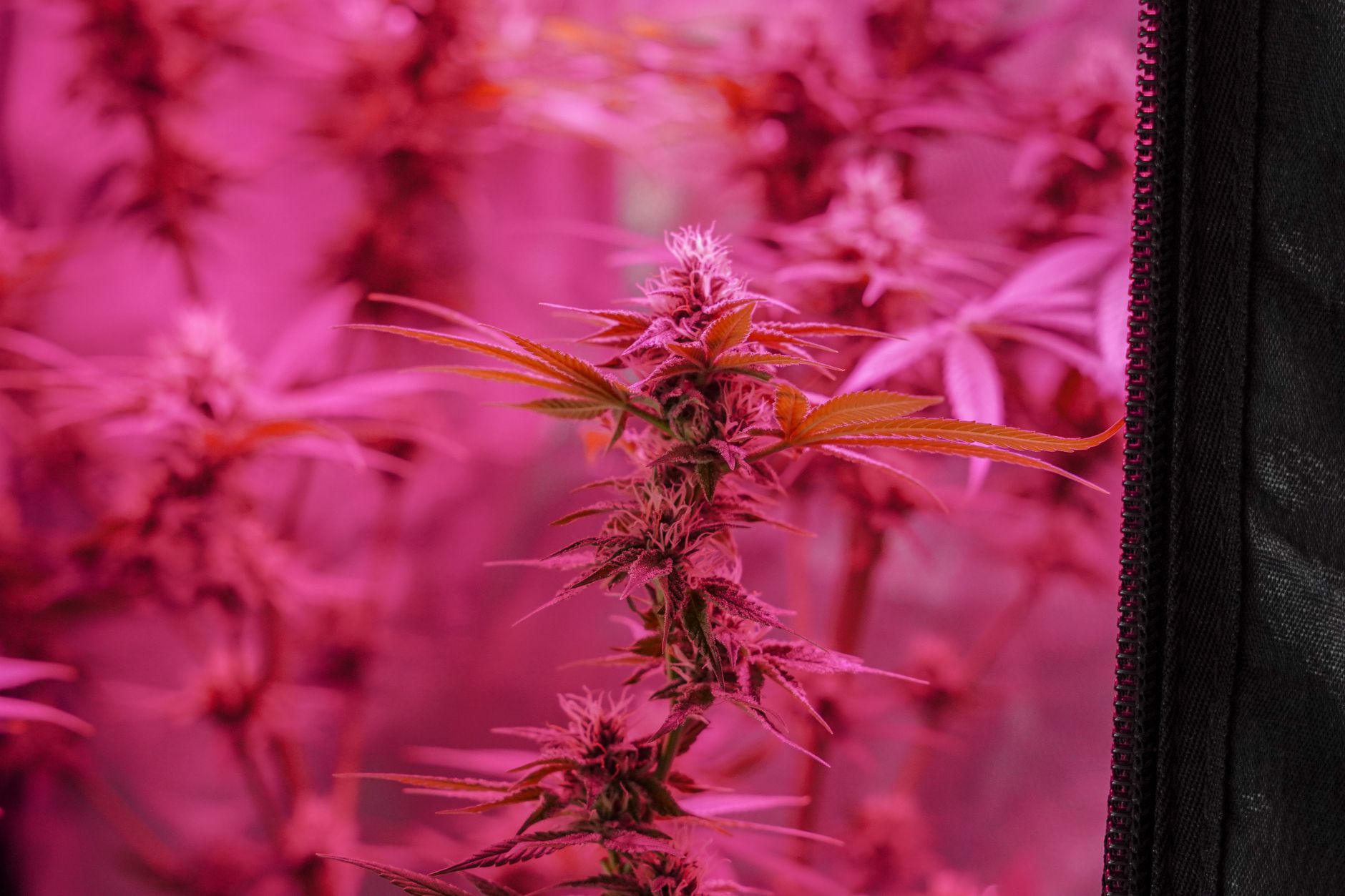
Cannabis grow lights are the engine of every indoor operation. Light quality, intensity, and spectrum directly determine yield and potency.
This guide compares LED, HPS, and CMH lights, then covers schedules, DLI, and budget setups for both autoflower and feminized seed grows.
Table of Contents
LED vs HPS vs CMH Comparison
This side-by-side comparison covers the three main grow light technologies. Use it to make an informed decision.
| Feature | LED | HPS | CMH / LEC |
|---|---|---|---|
| Efficiency | 2.5-3.0 umol/J | 1.5-1.7 umol/J | 1.7-2.0 umol/J |
| Heat output | Low-Moderate | Very High | High |
| Spectrum | Full spectrum | Red/Orange heavy | Full spectrum, UV |
| Lifespan | 50,000-100,000 hrs | 10,000-24,000 hrs | 20,000-30,000 hrs |
| Upfront cost | $200-800+ | $100-300 | $200-500 |
| Running cost | Low | High | Moderate |
| Coverage (4x4) | 400-600W draw | 600-1000W | 2x 315W (630W) |
| Bulb replacement | Not needed | Every 2-3 grows | Every 3-4 grows |
| Best for | All growers, efficiency | Budget, cold rooms | Quality-focused |
In 2026, LED technology is the clear winner. Energy savings alone pay for the higher upfront cost within 1-2 grows.
Understanding PAR, PPFD, and Light Spectrum
These metrics determine how much usable light your plants actually receive. Understanding them helps you choose the right light.
PAR (Photosynthetically Active Radiation)
PAR spans from 400nm (blue) to 700nm (deep red). Not all light wavelengths are equally useful for cannabis plants.
PPFD (Photosynthetic Photon Flux Density)
PPFD measures how many PAR photons hit a square meter per second. This is the most important metric for grow lights.
Target these PPFD values for cannabis.
- Seedlings: 200-400 umol/m²/s for gentle early growth.
- Vegetative growth: 400-600 umol/m²/s for strong development.
- Flowering: 600-900 umol/m²/s for maximum bud production.
- Flowering with CO2: 900-1500 umol/m²/s for enhanced yields.
Light Spectrum
Blue light (400-500nm) promotes compact veg growth. Red light (620-700nm) drives flowering and bud development.
Full-spectrum LEDs perform best across all stages of the cannabis lifecycle.
Daily Light Integral (DLI) Explained
DLI measures total PAR light over 24 hours in mol/m²/day. PPFD tells you intensity; DLI gives the complete picture.
DLI Formula: PPFD x hours of light x 0.0036 = DLI
Target these DLI values for cannabis.
- Seedlings: 12-20 mol/m²/day for healthy starts.
- Vegetative growth: 25-40 mol/m²/day for vigorous development.
- Flowering: 40-65 mol/m²/day for maximum bud production.
Example: 700 PPFD x 12 hours x 0.0036 = 30.2 DLI. Below the 40-65 target, suggesting higher intensity or longer hours for autoflowers on 18/6.
DLI is especially useful for autoflower growers on 18-20 hour schedules. Longer light means optimal DLI with lower-intensity lights.
Light Schedules for Cannabis
Your schedule depends on seed type. Each has specific purposes and trade-offs.
| Schedule | Light / Dark | Use For | Notes |
|---|---|---|---|
| 18/6 | 18 on / 6 off | Photoperiod veg, autoflowers | Standard, good energy balance |
| 20/4 | 20 on / 4 off | Autoflowers | More DLI, slightly higher cost |
| 24/0 | 24 on / 0 off | Autoflowers (debated) | Max DLI but plants may need rest |
| 12/12 | 12 on / 12 off | Photoperiod flowering | Required to trigger flowering |
The 18/6 to 12/12 switch is non-negotiable for photoperiods. Ensure the dark period is completely uninterrupted.
For autoflowers, 18/6 is most popular and cost-effective. Some growers prefer 20/4 for slightly faster growth.
LED Grow Lights for Cannabis
Modern full-spectrum LEDs deliver more usable light per watt than any other technology. They run cooler and last for years.
Look for these features when shopping.
- Diode quality: Samsung LM301B and LM301H are the industry standard.
- Driver quality: Meanwell drivers are reliable and highly efficient.
- Efficiency: Look for 2.5+ umol/J, with top-tier exceeding 2.8.
- Spectrum: Mix of 3000K and 5000K diodes plus 660nm red.
- Dimmability: Essential for seedlings and managing summer heat.
Budget LEDs start around $200 CAD for a 2x2 tent. Quality 4x4 lights run $400-700 CAD. Avoid cheap unbranded LEDs.
HPS Grow Lights for Cannabis
HPS lights have been the cannabis standard for decades. While surpassed by LEDs, they remain viable for budget setups.
HPS offers these key advantages.
- Low upfront cost: A complete 600W setup costs under $150 CAD.
- Proven results: Decades of successful grows confirm their reliability.
- Beneficial heat: In Canadian basements during winter, HPS reduces heating needs.
- Simple setup: No electronics to configure, just plug in and grow.
Main drawbacks are high electricity cost, summer heat, and limited spectrum. Bulbs need replacing every 2-3 grows.
CMH Grow Lights for Cannabis
Ceramic Metal Halide sits between HPS and LED in performance. It produces a remarkably natural spectrum including UV light.
Here is why some growers prefer CMH.
- Excellent spectrum: Closest to natural sunlight of any HID light type.
- Better than HPS: About 10-15% more efficient with better colour rendering.
- Good heat balance: Less heat than HPS but enough to warm Canadian spaces.
- Proven flower quality: Many craft growers prefer CMH for terpene production.
A 315W CMH covers a 3x3 foot area. Two fixtures provide excellent 4x4 tent coverage.
Light Distance and Intensity
Correct light distance is critical. Too close causes bleaching; too far wastes energy and stretches plants.
Use this table for recommended hanging heights.
| Light Type | Seedling Distance | Veg Distance | Flower Distance |
|---|---|---|---|
| LED (200-300W) | 24-30 inches | 18-24 inches | 12-18 inches |
| LED (400-600W) | 30-36 inches | 20-28 inches | 14-22 inches |
| HPS 400W | 24-30 inches | 16-22 inches | 12-18 inches |
| HPS 600W | 30-36 inches | 20-26 inches | 16-24 inches |
| CMH 315W | 24-30 inches | 18-24 inches | 14-20 inches |
Signs of Too Much Light
- Bleached tips: White or pale tips on upper leaves signal light burn.
- Taco-ing: Leaves curling upward at the edges to escape intensity.
- Brown spots: Yellow or brown spots on the upper canopy only.
- Fox-tailing: Elongated bud growth closest to the light source.
With dimmable LEDs, start at 50% for seedlings and increase gradually as plants mature.
Budget Grow Light Setups for Canada
Great cannabis does not require expensive lighting. Here are setups at three price points.
Budget ($100-200 CAD)
- Light: 100-150W LED panel from a reputable brand.
- Coverage: 2x2 foot space for 1-2 plants.
- Best for: Autoflower seeds in a small closet or tent.
- Electricity: Approximately $15-25 CAD per month.
Mid-Range ($300-500 CAD)
- Light: 240-320W LED bar-style with Samsung diodes.
- Coverage: 3x3 to 4x4 foot tent for 2-4 plants.
- Best for: Any seed type including feminized seeds.
- Electricity: Approximately $25-45 CAD per month.
Premium ($500-800+ CAD)
- Light: 480-640W top-tier LED with highest efficiency diodes.
- Coverage: Full 4x4 to 5x5 foot area for 4+ plants.
- Best for: Maximizing yield per square foot with even coverage.
- Electricity: Approximately $40-65 CAD per month.
Canadian electricity rates vary by province. Ontario, Quebec, and BC have lower rates, making LED efficiency important everywhere.
Common Lighting Mistakes
Even experienced growers make lighting errors. Avoiding these protects your plants and wallet.
Watch out for these frequent pitfalls.
- Buying on advertised wattage: Cheap LEDs misrepresent wattage. Check actual wall draw.
- Wrong distance: Use a PPFD meter or manufacturer guidelines throughout the grow.
- Ignoring edge drop-off: PPFD decreases at the edges, so center your plants.
- Light leaks during dark: Even small leaks cause hermaphroditism or reveg.
- Full power on seedlings: Start at 40-50% intensity and increase gradually.
- Ignoring electricity costs: Calculate monthly cost before choosing your light setup.
Planning your lighting setup before starting saves money and produces better results from the first harvest.
Frequently Asked Questions
What is the best grow light for cannabis?+
How many watts do I need to grow cannabis?+
What light schedule should I use for cannabis?+
What is DLI and why does it matter?+
Is LED better than HPS for growing cannabis?+
How far should grow lights be from cannabis plants?+
Do cannabis plants need darkness?+
What is PAR and PPFD in cannabis growing?+
Can I use regular light bulbs to grow cannabis?+
Got your lights ready? Browse our premium cannabis seeds for indoor growing.
Royal King Seeds Editorial Team
Editorial Team
Our editorial team cites public breeder documentation, lab COAs (SC Labs and Steep Hill), Health Canada guidance, and aggregated grower journals. We do not fabricate first-party trial data.