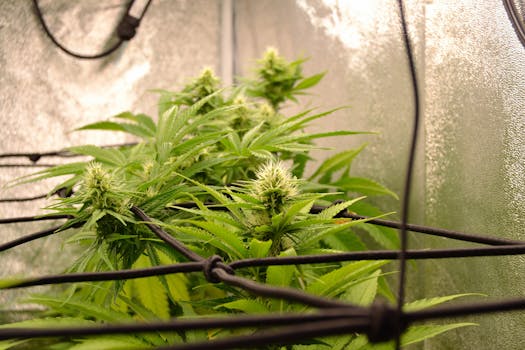
Understanding the cannabis grow timeline is essential for planning. Each growth stage has specific care requirements and durations.
This guide breaks down the complete timeline week by week for both autoflowering and photoperiod (feminized) strains.
Table of Contents
Cannabis Grow Timeline: Autoflower vs Photoperiod
Approximate weeks from seed to harvest
Cannabis Growth Stages Overview
The cannabis grow timeline has six major stages. Each has distinct characteristics, nutrient needs, and environmental requirements.
This table summarizes all six stages at a glance.
| Stage | Duration | Light Cycle | Key Focus |
|---|---|---|---|
| Germination | 3-10 days | Darkness | Moisture, warmth (22-26°C) |
| Seedling | 1-3 weeks | 18/6 | Gentle light, humidity 65-75% |
| Vegetative | 3-8 weeks | 18/6 | Nitrogen, training, growth |
| Pre-Flower | 1-2 weeks | 12/12 (photo) | Transition nutrients, stretch |
| Flowering | 7-11 weeks | 12/12 (photo) | Bloom nutrients, P and K |
| Harvest | 1-2 weeks | — | Flush, check trichomes |
Total timeline ranges from 8-12 weeks for autoflowers to 14-24 weeks for photoperiod strains, not including drying and curing.
Autoflower vs Photoperiod Timeline Comparison
The biggest timeline difference is autoflowering vs photoperiod. This comparison helps you choose based on time and goals.
Here is how the two types compare across key factors.
| Factor | Autoflower | Photoperiod |
|---|---|---|
| Total Grow Time | 8-12 weeks | 14-24 weeks |
| Vegetative Period | 3-4 weeks (fixed) | 4-8+ weeks (grower controlled) |
| Flowering Period | 5-7 weeks | 7-11 weeks |
| Light to Trigger Flower | Not needed (age-based) | 12/12 light switch required |
| Harvests Per Year (Indoor) | 4-5 cycles | 2-3 cycles |
| Average Yield | 30-100g per plant | 50-200g per plant |
| Best For | Speed, beginners, small spaces | Maximum yield, experienced growers |
For maximum harvests per year, autoflowering seeds allow 4-5 complete cycles annually. Photoperiod growers trade speed for larger harvests.
Stage 1: Germination (Week 1)
The timeline begins with germination. The seed absorbs water, cracks, and pushes out a white taproot over 1-7 days.
Ideal Conditions
Maintain these conditions for successful germination.
- Duration: 1-7 days depending on seed freshness and the method used.
- Temperature: Hold steady at 22-26°C throughout the process.
- Humidity: Keep at 70-80% using a dome or covered container.
- Light: Complete darkness is preferred during germination.
- Method: Paper towel, water soak, or direct soil all work well.
For detailed instructions, see our Cannabis Seed Germination Guide. Plant the seed once the taproot reaches 0.5-1.5 cm.
Stage 2: Seedling Stage (Weeks 1-3)
After breaking through soil, the seedling stage begins. The first round leaves open and true serrated leaves develop.
Week 1-2 Seedling Care
Seedlings are fragile and need gentle conditions.
- Light: 18/6 schedule with LED at 60-80 cm above the canopy.
- Water: Mist soil surface lightly and do not overwater tiny roots.
- Temperature: 22-26°C by day and 18-22°C at night.
- Humidity: 65-75% with a dome for the first week.
- Nutrients: None needed because seed starter soil provides enough for 1-2 weeks.
By week 2-3, your seedling should have 3-4 sets of true leaves. Tall, thin stems mean the light is too far away.
Stage 3: Vegetative Stage (Weeks 3-8)
The vegetative stage builds your plant's structure. It grows in size and prepares to support heavy buds during flowering.
Weekly Vegetative Progress
Here is what to expect each week of vegetative growth.
- Week 3-4: Rapid leaf development begins, so start nitrogen-rich nutrients at half strength and begin LST.
- Week 4-5: Noticeable daily growth occurs, so increase nutrients and transplant if rootbound.
- Week 5-6: Thick canopy develops, so defoliate crowded lower growth and continue training.
- Week 6-8: Decide when to flip to 12/12 because plants stretch 50-100% during flowering transition.
Autoflower Note: Autoflowering strains have a fixed 3-4 week veg period. Focus on maximizing light and nutrition during this short window for best yields.
Stage 4: Pre-Flowering Transition (Week 8-9)
Pre-flowering is the transition to flower production. It starts when you switch to 12/12 for photoperiod or automatically for autoflowers.
What Happens During Pre-Flower
Several important changes occur during this 1-2 week transition.
- The stretch: Plants grow 50-100% taller in the first 2 weeks after light flip.
- Sex identification: White pistils appear for females, and males show pollen sacs. Feminized seeds eliminate this concern.
- Nutrient transition: Begin switching from veg to bloom nutrients over 1-2 weeks.
- Stop heavy training: Do not top or FIM once pre-flower begins, but light leaf tucking is fine.
Once you see clusters of white pistils at multiple bud sites, the plant has entered full flowering.
Stage 5: Flowering Stage (Weeks 9-18)
Flowering is the longest and most critical phase. Buds form, swell, and develop the trichomes and terpenes that determine quality.
Flowering Week by Week
Here is what happens during each phase of flowering.
- Weeks 1-2: Stretch continues, white pistils appear, and you switch to full bloom nutrients.
- Weeks 3-4: Bud sites form and swell, stretch slows, and you reduce humidity to 45-55%.
- Weeks 5-6: Buds thicken rapidly, trichomes become visible, and you check the carbon filter.
- Weeks 7-8: Buds near final size, fan leaves may yellow, and you start monitoring trichomes.
- Weeks 8-11: Final ripening occurs as trichomes shift from clear to milky to amber. Flush with plain water.
Flowering Time by Strain Type
This table shows typical flowering durations by strain type.
| Strain Type | Flowering Time | Characteristics |
|---|---|---|
| Indica | 7-9 weeks | Dense buds, shorter plants, faster finish |
| Hybrid | 8-10 weeks | Balanced traits, moderate stretch |
| Sativa | 10-14 weeks | Airy buds, tall plants, longer finish |
| Autoflower | 5-7 weeks | Compact, fast, fixed schedule |
Choose your strain based on how much time you can commit. Indica strains and autoflowers finish fastest.
Stage 6: Harvest Window (Week 18-20)
The harvest window is a 1-2 week period of peak potency. Timing your harvest within this window lets you dial in the exact effect.
Trichome Harvest Guide
Check trichomes with a jeweler's loupe to find the ideal harvest point.
- Mostly clear trichomes: Too early with low potency and a racy effect.
- Mostly milky/cloudy: Peak THC with an energetic, cerebral effect for most growers.
- 30-50% amber trichomes: THC degrading to CBN for a more relaxing, sedative effect.
- Mostly amber: Past peak potency with heavy sedation, so harvest immediately.
Harvest Steps
Follow these steps for a clean harvest that preserves trichomes.
- Flush with plain pH-balanced water for the final 7-14 days.
- Cut branches individually or chop the whole plant at the base.
- Remove large fan leaves immediately (wet trim).
- Optionally do a detailed trim now or after drying (dry trim).
Proper harvest technique maximizes trichome and terpene preservation.
Drying and Curing Timeline
The timeline does not end at harvest. Drying and curing dramatically affect final quality and flavor.
Drying (7-14 Days)
Proper drying removes moisture while preserving cannabinoids.
- Setup: Hang trimmed branches upside down in a dark room.
- Temperature: Maintain 18-22°C throughout drying.
- Humidity: Keep at 45-55% for optimal drying speed.
- Airflow: Gentle circulation without direct fan on buds.
- Ready test: Small stems snap instead of bending when dry.
Curing (2-8+ Weeks)
Curing develops smooth flavor and full terpene expression.
- Jar storage: Place dried buds in glass mason jars at 75% capacity.
- Week 1: Burp jars 2-3 times daily for 15 minutes.
- Week 2-4: Burp once daily as moisture levels stabilize.
- Week 4+: Burp every few days because quality improves with each week.
- Humidity packs: Use Boveda packs to maintain 58-62% if needed.
Minimum cure is 2 weeks, but 4-8 weeks produces noticeably smoother smoke. Properly stored cannabis keeps quality for 6-12 months.
Autoflower Week-by-Week Timeline
Autoflowering strains have a compressed, predictable timeline. Here is a typical 10-week autoflower breakdown.
This table covers each week from seed to harvest for a standard autoflower.
| Week | Stage | What to Expect | Key Actions |
|---|---|---|---|
| 1 | Germination / Seedling | Seed sprouts, cotyledons emerge | Light misting, 18/6 light |
| 2 | Seedling | First true leaves, 2-3 nodes | Begin light nutrients at 1/4 strength |
| 3 | Early Veg | Rapid leaf growth, 4-5 nodes | Increase nutrients, start LST |
| 4 | Late Veg / Pre-Flower | First pistils appear, stretch begins | Transition to bloom nutrients |
| 5 | Early Flower | Bud sites forming, stretch continues | Full bloom nutrients, stop LST |
| 6 | Mid Flower | Buds swelling, trichomes visible | Reduce humidity to 45-55% |
| 7 | Mid-Late Flower | Buds thickening, strong smell | Monitor trichomes, support branches |
| 8 | Late Flower | Buds dense, pistils darkening | Begin flush with plain water |
| 9 | Ripening | Trichomes milky, fan leaves yellow | Continue flush, prepare to harvest |
| 10 | Harvest | 60-70% milky trichomes, pistils brown | Chop, trim, hang to dry |
Autoflowers offer the fastest seed-to-harvest path for Canadian growers.
Factors That Affect the Cannabis Grow Timeline
Several factors speed up or slow down your timeline. Understanding these helps you plan accurately and avoid delays.
These variables have the most impact on how long your grow takes.
- Genetics: The single biggest factor because indica and autoflower strains have faster timelines.
- Light intensity: More light accelerates growth, and underpowered lights slow development.
- Temperature: Cannabis grows fastest at 22-28°C, and below 18°C slows growth significantly.
- Nutrients: Proper feeding supports fast growth, while deficiencies can add weeks.
- Stress: Light leaks, temperature swings, and pests all delay flowering.
- Growing medium: Hydro produces faster veg growth than soil, and coco falls in between.
By optimizing these factors, you keep your timeline on track and avoid harvest delays.
Planning Your Grow Calendar for Canada
Canadian growers need to plan around the climate. Indoor growers can start any time, but outdoor growers must time the summer season.
Indoor Grow Calendar
Indoor growers can start any time of year. With 10-week autoflowers, you can complete 4-5 full cycles annually.
Outdoor Grow Calendar (Southern Canada)
Time your outdoor grow to match Canada's short summer season.
- April: Start seeds indoors under lights for a head start.
- Late May - Early June: Transplant outdoors after the last frost date.
- June - August: Vegetative growth thrives under long summer days.
- Late August - September: Shortening days trigger flowering in photoperiod strains.
- September - Early October: Harvest before heavy frost arrives.
For outdoor grows, autoflowering seeds planted in June harvest by August-September, well before frost.
Canadian Legal Reminder: Under the Cannabis Act 2018, you can grow up to 4 plants per household in most provinces. Quebec and Manitoba currently prohibit home cultivation.
Frequently Asked Questions
How long does it take to grow cannabis from seed to harvest?+
Autoflowering strains take 8-12 weeks from seed to harvest. Photoperiod strains take 14-24 weeks depending on the length of the vegetative stage and the strain's flowering time. Add 3-8 weeks for drying and curing.
What is the fastest cannabis strain to grow?+
Fast autoflowering strains can be harvested in as little as 8 weeks (56 days) from seed. Some ultra-fast varieties finish in 60-65 days. These compact strains are ideal for Canadian growers wanting quick turnarounds.
How long is the flowering stage for cannabis?+
Flowering typically lasts 7-11 weeks. Indica strains flower in 7-9 weeks, hybrids in 8-10 weeks, and pure sativa strains can take 10-14 weeks. Autoflowers flower for about 5-7 weeks as part of their compressed timeline.
Can I speed up the cannabis grow timeline?+
You can shorten the timeline by choosing autoflowering strains, using 20/4 light schedules, maintaining optimal temperature (22-28°C), and providing consistent nutrients. The flowering stage length is mostly genetic and cannot be significantly shortened.
How long does the vegetative stage last?+
For photoperiod plants, the vegetative stage lasts as long as you keep lights on 18/6, typically 4-8 weeks indoors. Autoflowering plants have a fixed vegetative period of about 3-4 weeks that you cannot extend.
When should I switch to 12/12 for flowering?+
Switch photoperiod plants to 12/12 when they reach about half the desired final height. Plants typically stretch 50-100% during the first 2 weeks of flowering. Most indoor growers flip after 4-6 weeks of vegetative growth.
How do I know when cannabis is ready to harvest?+
Check trichomes with a jeweler's loupe or digital microscope. Harvest when 60-70% of trichomes appear milky/cloudy white. Also look for darkened pistils (60-80% brown) and swollen, dense calyxes as secondary indicators.
Does drying and curing add to the total timeline?+
Yes. Drying takes 7-14 days and curing takes a minimum of 2 weeks, ideally 4-8 weeks. Plan for an additional 3-8 weeks after harvest before your cannabis is ready for consumption.
How long do autoflowers take compared to photoperiod?+
Autoflowers are significantly faster — typically 8-12 weeks vs 14-24 weeks for photoperiod strains. Autoflowers skip the extended vegetative period because they flower based on age rather than light schedule changes.
What cannabis growth stage takes the longest?+
The flowering stage takes the longest at 7-11 weeks for most strains. For photoperiod growers who extend the vegetative period, veg can also run 6-8+ weeks. Combined, these two stages make up the bulk of the grow timeline.
Start Your Cannabis Grow Timeline Today
Choose your strain and begin your seed-to-harvest journey. All orders ship discreetly across Canada with a germination guarantee.
Royal King Seeds Editorial Team
Editorial Team
Our editorial team cites public breeder documentation, lab COAs (SC Labs and Steep Hill), Health Canada guidance, and aggregated grower journals. We do not fabricate first-party trial data.